

Generative engines answer questions by quoting pages. This is what makes a page quotable, and how to check whether yours already is.
Key takeaways
- Answer engines quote passages, not pages, so every section needs one sentence that stands alone.
- Structure beats volume: headings, tables and lists get parsed, long undifferentiated prose does not.
- Being cited needs a verifiable claim, a date and a named author. Unattributed copy rarely gets picked up.
- Check what the engines already say about you before rewriting anything.
On this page
What generative engine optimisation actually is
Generative engine optimisation is the practice of making a page easy for an AI answer engine to quote correctly. Classic SEO competes for a ranked list of links. A generative engine instead reads a handful of sources and writes one answer, citing what it used. The unit of competition moves from the page to the passage.
That difference matters more than it sounds. A page can rank well and still never be quoted, because nothing in it can be lifted without the surrounding context. The fix is rarely more words: it is putting the claim, the number and the qualifier in the same sentence.
Why some pages get cited and others do not
Cited pages tend to state something specific, attributable and dated. When two sources say the same thing, the engine leans on whichever is easier to verify and safer to attribute.
Self-contained passages
A quotable sentence survives being cut out of the page. “It improved by roughly a third” does not. “Organic clicks rose 34% in the quarter after launch” does.
Visible evidence
Name the source of a figure in the sentence that uses it. An engine reproducing your claim inherits your evidence, or your vagueness.
If a sentence cannot be quoted on its own, it will not be quoted at all.
Serhii Yelbaiev, Well Web Marketing
What to change on the page
Lead every section with the answer, then explain it. The inverted pyramid that newsrooms have used for a century happens to be the format answer engines parse best.
- Open each H2 with a one-sentence answer in bold, then support it.
- Give every heading an explicit anchor so passages can be deep-linked.
- Put comparable figures in a table rather than a paragraph.
- Date your claims, and say when they were last checked.
- Answer the adjacent questions on the same page instead of scattering them.
How to measure it
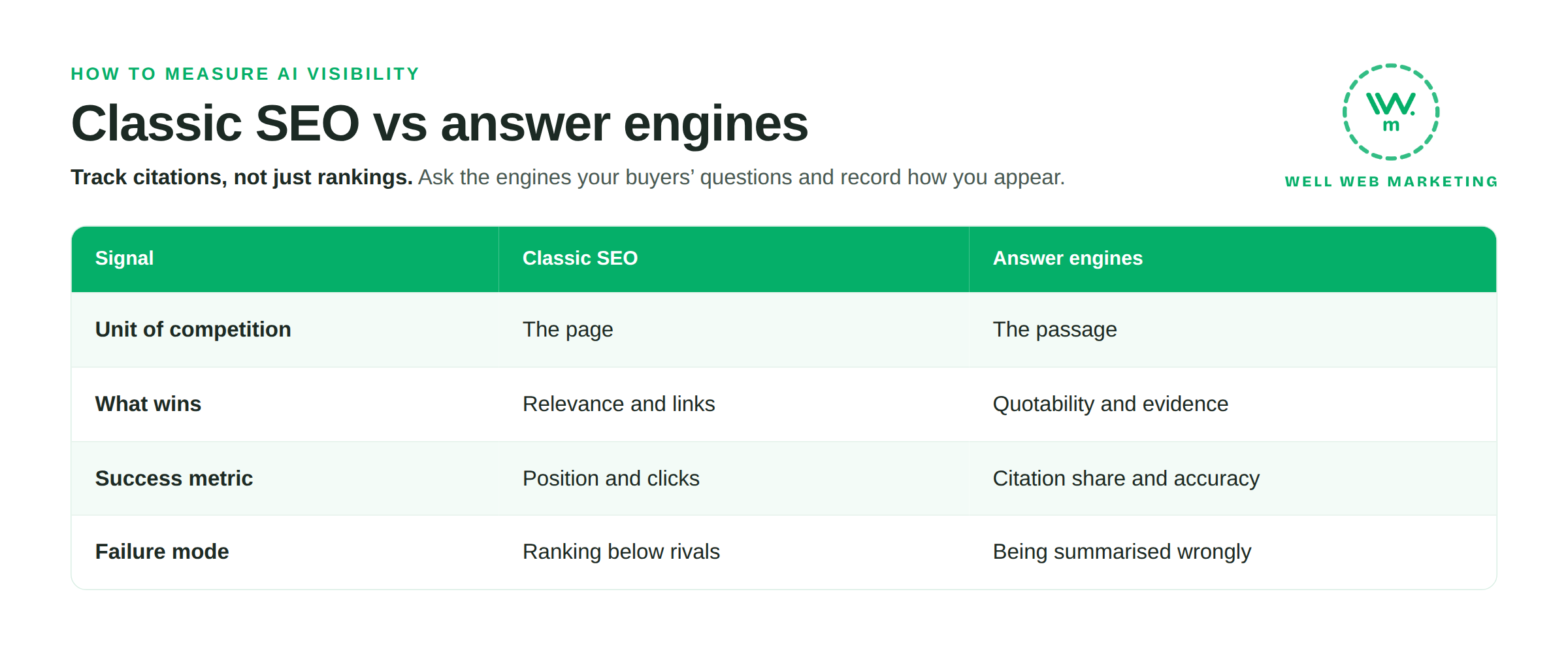
Track citations, not just rankings. Ask the engines the questions your buyers ask, record whether you appear, and watch how the answer describes you.
| Signal | Classic SEO | Answer engines |
|---|---|---|
| Unit of competition | The page | The passage |
| What wins | Relevance and links | Quotability and evidence |
| Success metric | Position and clicks | Citation share and accuracy |
| Failure mode | Ranking below rivals | Being summarised wrongly |
Click to download this table as an image
If you would rather not track this by hand, our AI visibility boost samples the answer engines for your questions every week and reports what they say about you.
Frequently asked questions
No. Answer engines still crawl and rank before they summarise, so the technical and content basics carry over. GEO adds a layer about how quotable each passage is.
Usually four to eight weeks on an established domain, the page has to be recrawled and the answer engines have to refresh their index of it.
It helps, but it does not rescue vague copy. Structured data describes content that already exists, it cannot make an unquotable sentence quotable.
Sources and method
Figures come from our own client reporting across 40 sites between March 2025 and January 2026, measured in Google Search Console and by weekly prompt sampling against four answer engines. Last reviewed February 2026.