
Most segmentation ends as a slide nobody uses. The short answer: group customers by the situation and need that made them buy, then check each group against real sales data. Age and income come second. Keep it to three to five segments you can actually reach and speak to differently.
Key takeaways
- Customer segmentation means splitting your market into groups that need similar things and respond to similar messages.
- Needs and behaviour predict buying better than demographics do.
- A useful segment is measurable, big enough, reachable and responds differently from the others.
- Segmentation only pays when the offer or the message actually changes per segment.
On this page
What is customer segmentation?
Customer segmentation is dividing your market into smaller groups of people who share needs and are likely to respond the same way to your marketing. That is close to the textbook definition in OpenStax’s Principles of Marketing. Bain & Company adds the part that matters for a business: it works best when you tailor offers to the most profitable segments and serve them better than anyone else.
The five types of segmentation
Textbooks list four bases. We add a fifth, needs-based, because it is usually the most useful.
| Type | Groups people by | Example | Good for |
|---|---|---|---|
| Geographic | Where they are | Country, city, delivery zone | Local services, shipping, language |
| Demographic | Who they are | Age, income, job, company size | Quick first cut, ad targeting |
| Psychographic | What they value | Lifestyle, attitudes, personality | Brand tone and creative |
| Behavioural | What they do | Purchase frequency, loyalty, readiness to buy | Email, retention, remarketing |
| Needs-based | The job they need done | “Replace a freelancer who disappeared” | Offers, pricing, positioning |
Click to download this table as an image

The needs-based approach comes from the “jobs to be done” idea. As Clayton Christensen and his co-authors put it in Harvard Business Review in 2016, when we buy a product we “hire” it to help us do a job.
9 tips for a better segmentation strategy
- Start with your best customers, not the whole market. List the ten who are most profitable, happiest and easiest to work with. What they share is your first segment.
- Segment by situation and need first. In Christensen’s milkshake study, 40% of milkshakes were bought early in the morning by commuters who wanted a slow, filling breakfast for the drive. Their age explained nothing; their situation explained everything.
- Use the data you already have. Your CRM, orders and analytics show purchase value, frequency and how people found you. That is behavioural segmentation for free.
- Keep it to three to five segments. More than that and nobody on your team will remember them, let alone write different messages for each.
- Test every segment on four points. Can you measure it? Is it big enough to be worth it? Can you reach it through a channel you use? Does it respond differently from the others? Drop any segment that fails one.
- Name segments after situations, not made-up people. “Switching agencies after a bad launch” tells your team what to say. “Marketing Mary, 38” does not.
- Change the offer or the message for each segment. McKinsey found in 2021 that 71% of consumers expect personalised interactions and that personalisation typically lifts revenue by 10 to 15%. If nothing changes per segment, the work was wasted.
- Test before you rebuild. Run one small campaign or email per segment and compare results before you redesign your website around them.
- Review twice a year. Markets, prices and competitors move. A segment that paid last year can shrink quietly.
The best segment is rarely an industry. It is usually a moment: a launch that went wrong, a team that grew too fast, a supplier who stopped answering.
Serhii Yelbaiev, Well Web Marketing
A worked example
Here is how a small accounting firm might segment its clients. This is an illustration, not a real client.
| Segment (situation) | What they need | Offer | Where to reach them |
|---|---|---|---|
| Just registered a company | Set-up done right, no surprises | Fixed-price first-year package | Search, startup communities |
| Outgrew their spreadsheet | Proper books and payroll | Migration plus monthly bookkeeping | Search, software partner pages |
| Unhappy with current accountant | Someone who answers | Free switch with a response-time promise | Search, referrals, reviews |
Click to download this table as an image
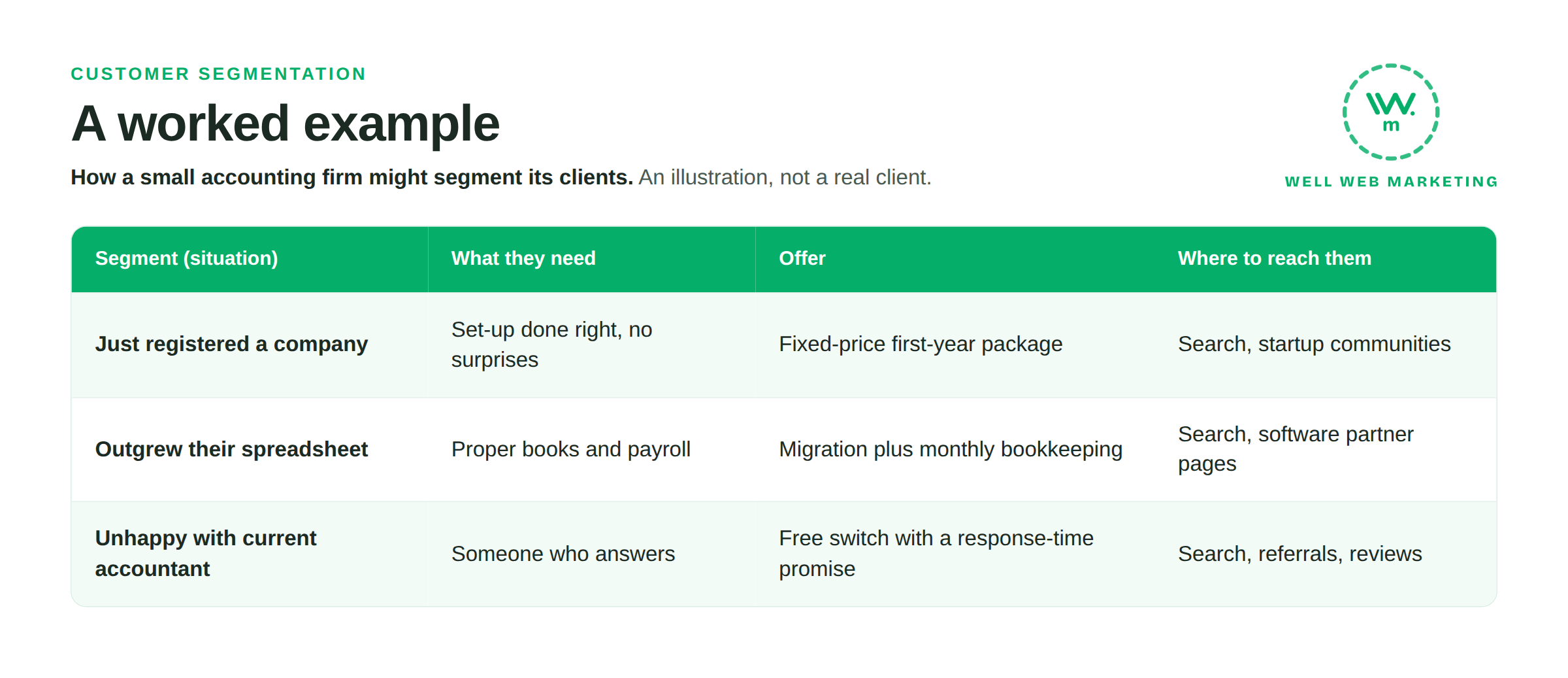
Notice that all three could be the same age and size. What differs is the moment they are in, so the headline, the offer and the landing page differ too.
Common misconception: many people think segmentation means sorting customers by age, gender and income. In fact, as Daniel Yankelovich and David Meer argued in Harvard Business Review in 2006, those traits rarely predict what people buy. Needs and behaviour do.
Segmentation, targeting and positioning
Segmentation decides who the groups are. Targeting picks which groups to serve. Positioning decides why they should choose you. Marketers call this STP, and the steps only work in that order.
Once you have your segments, read our guide to marketing positioning to decide what you stand for with each. Then put segments to work in email marketing, where splitting a list pays back fastest.
Frequently asked questions
Geographic, demographic, psychographic and behavioural. Many marketers add a fifth, needs-based segmentation, which groups people by the problem they want solved.
Three to five. Fewer than three usually means you haven’t looked closely, and more than five is hard to act on with a small team.
Segmentation maps all the groups in your market. Targeting is the choice of which of those groups you will actually spend money and effort on.
Less than you think. Your order history, CRM notes and ten short customer conversations are enough to find your first segments. See what to measure in web analytics to add behaviour data.
Want your customer data organised so segments update themselves? Our CRM Setup and Sales Automation box sets that up.
Sources and method
- OpenStax, Principles of Marketing: market segmentation (2023)
- Bain & Company, Management Tools: Customer Segmentation (2018)
- Yankelovich and Meer, Rediscovering Market Segmentation, Harvard Business Review (2006)
- Christensen et al., Know Your Customers’ Jobs to Be Done, Harvard Business Review (2016)
- HBS Working Knowledge, Clay Christensen’s Milkshake Marketing (2011)
- McKinsey, The value of getting personalization right, or wrong, is multiplying (2021)