
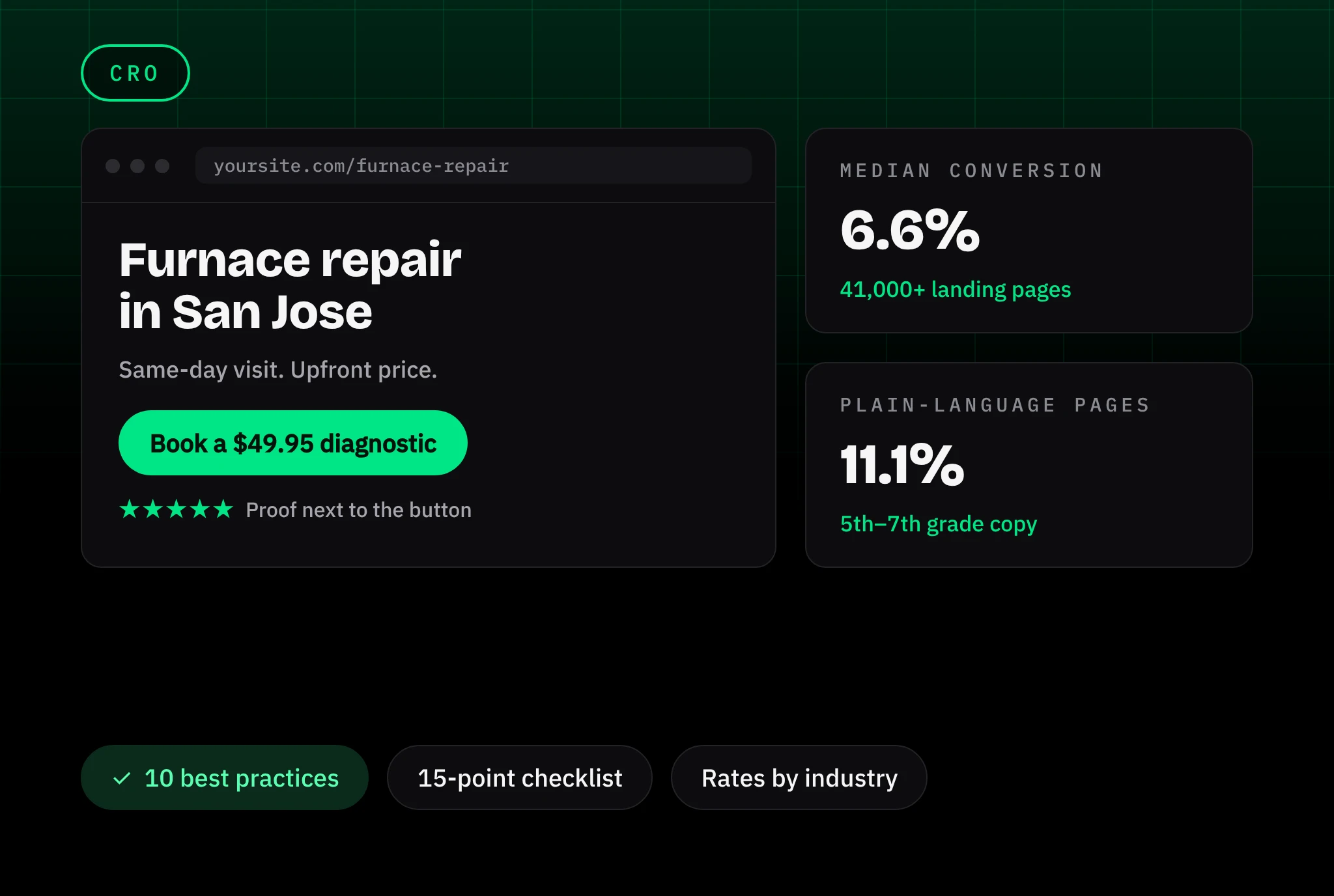
A landing page converts when it keeps the promise of the ad or email that brought the visitor, asks for one action and makes that action easy on a phone. The median landing page converts 6.6% of visitors, according to Unbounce’s 2024 benchmark of more than 41,000 pages, and pages written in plain, short sentences reach 11.1%. Below are the ten practices we apply first, conversion rates by industry, a 15-point checklist and an example from our own client work.
Key takeaways
- Match the headline to the ad or email word for word where you can.
- One page, one action. Remove the menu and any link that leads away from the form or the phone number.
- Write simply: pages at a 5th to 7th grade reading level convert at 11.1%, more than twice the 5.3% of professional-level copy.
- Design for the phone first: about 83% of visits are on mobile, yet desktop still converts 8% better on average.
- Judge your rate against your own industry: medians run from 3.8% for SaaS to 12.3% for entertainment.
On this page
What is a landing page?
A landing page is a single page built for one campaign and one goal, such as a call, a booking or a form. It is not your homepage. A homepage serves everyone; a landing page serves the people who clicked one ad, so every line can speak to that click.
Paid ads get the most out of landing pages, because you pay for every visit. If you are setting up campaigns for the first time, start with our paid ads foundations guide.
10 landing page best practices
These are the ten changes we make first on client landing pages, in the order we check them. Fixes 1 to 3 are about the message, 4 to 7 about trust and the form, 8 to 10 about speed and measurement.
1. Match the headline to the click
Repeat the words of the ad, keyword or email subject in the H1. Someone who searched “furnace repair San Jose” should read “Furnace repair in San Jose”, not “Comfort solutions for your home”. If one page serves many ad groups, dynamic text replacement, offered by many landing page builders, swaps the headline to match the keyword that brought the visitor.
2. One page, one action
Pick the one thing you want; for a service business that is usually a phone call. Remove the main menu and footer links. On our HVAC ad pages we keep only the logo, the offer, the phone number and a short form.
3. Say the offer above the fold
On a phone screen, the visitor should see what you offer, for whom, and what it costs or what they get, before they scroll.
4. Write at a 5th to 7th grade reading level
Short words, short sentences. In Unbounce’s 2024 benchmark, pages written this way converted at 11.1%, against 5.3% for professional-level copy. Of the three copy traits Unbounce compared, difficult words had the strongest negative link to conversion (−24.3%), ahead of reading time (−19.4%) and word count (−18.6%). Financial services is the exception, where more complex language can work.
5. Put proof next to the button
A review with a name, a rating with its count, a guarantee, a license number. Put it next to the button, because that is where visitors hesitate.
6. Make the button say what happens
“Get my free quote” or “Book a $49.95 diagnostic”, not “Submit”. Use one button color that nothing else on the page uses.
7. Ask for as little as you can
Every form field is a reason to stop. Ask only for what you need to reply: often name, phone and one question.
8. Design for the phone first
About 83% of landing page visits in the Unbounce data were on mobile, yet desktop still converted 8% better on average. Financial services runs the other way: there mobile pages converted at 11.5% against 9% on desktop. Use tap-to-call, big buttons and no pop-ups that cover the form.
9. Make it fast
Aim for Google’s “good” thresholds on a phone: Largest Contentful Paint of 2.5 seconds or less, so the offer appears quickly, and Interaction to Next Paint of 200 milliseconds or less, so the form and the call button respond the moment they are tapped. Compress images and drop scripts the page doesn’t need; our technical SEO guide covers the usual culprits.
10. Track it, then test one change at a time
Count the conversion in GA4 and in the ad platform before you change anything. If the two disagree, check consent first: visitors who decline cookies drop out of GA4 unless consent mode is set up, see our consent mode guide. Then test one change per round, starting with the headline. Our A/B testing guide explains how long to run a test.
Average landing page conversion rates by industry
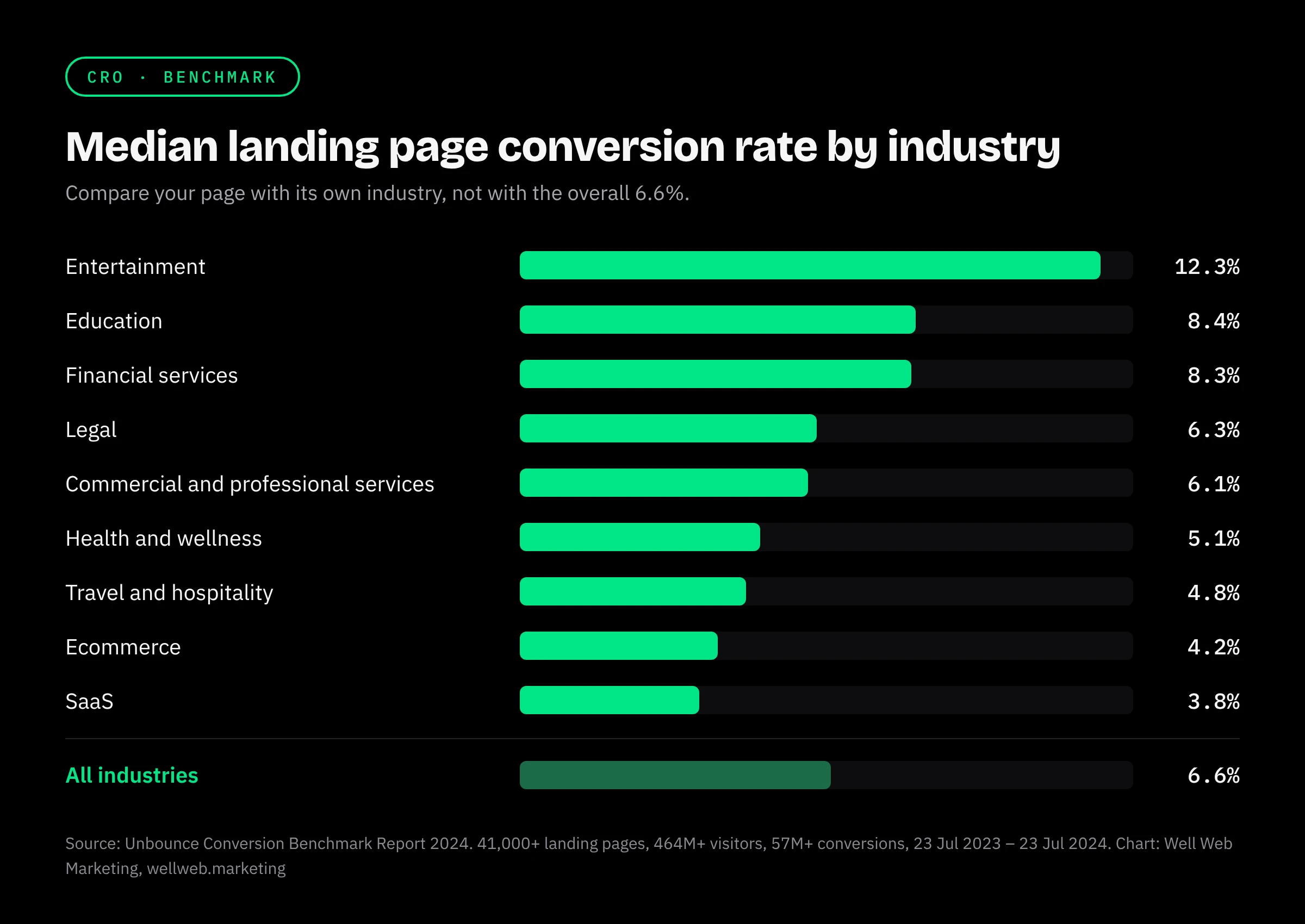
The median landing page converts at 6.6%, but industries range from 3.8% for SaaS to 12.3% for entertainment. Compare your page with its own industry, not with the overall figure.
| Industry | Median conversion rate |
|---|---|
| Entertainment | 12.3% |
| Education | 8.4% |
| Financial services | 8.3% |
| Legal | 6.3% |
| Commercial and professional services | 6.1% |
| Health and wellness | 5.1% |
| Travel and hospitality | 4.8% |
| Ecommerce | 4.2% |
| SaaS | 3.8% |
| All industries | 6.6% |
Traffic source matters as much as industry. In the same report, email traffic converted at 19.3% on average, paid social at 12% and paid search at 10.9%. Within paid social, Instagram (17.9%) and Facebook (13%) led; within paid search, Google averaged 11.3%, 41% higher than Bing.
From our work: a focused page and offer vs a broad one
For a Bay Area HVAC company, a narrow campaign with one offer brought leads at $34 each, a quarter of the $138 our broad search campaigns cost at their best. By our estimate from campaign data in that market, a typical HVAC search lead there costs $200–250.
The narrow campaign targeted water heater repair and replacement only, at $1.59 per click. We rebuilt it in the first week of February 2025; over the next 35 weeks it averaged $34 per lead across 328 leads. A lead is a tracked call or form submission.
| Campaign | Cost per lead |
|---|---|
| Typical Bay Area HVAC search (our estimate from campaign data) | $200–250 |
| Our general HVAC search, best period | $138 |
| Local Services Ads, average | $77 |
| Water heater call campaign (one service, one offer) | $34 |
The focused setup followed the practices above: one service per campaign and page, the headline in the searcher’s words, one action (a call), and tracking checked weekly against the client’s call log. For the 2026 heating season we applied the same idea to 25 ad landing pages, one per service and area, each with a single $49.95 diagnostic offer. Full story and dates: HVAC marketing case study.
Landing page checklist (15 points)
Run through this before you send traffic to a page. If you answer no to any of the first five, fix that before anything else.
Message
- The H1 repeats the words of the ad, keyword or email that sends traffic here.
- A visitor can tell what you offer, for whom and at what price within five seconds on a phone.
- The page asks for one action, and every button leads to it.
- The main menu and links that lead away are removed.
- The copy reads at a 5th to 7th grade level: short words, short sentences.
Trust
- There is proof near the button: a named review, a rating with its count, a guarantee or a license number.
- Your business name, phone number and address match your ads and Google Business Profile.
- Any price or offer on the page is the one in the ad.
Action
- The button says what happens next (“Get my quote”), not “Submit”.
- The form asks only what you need to reply: often name, phone and one question.
- On a phone, the number is tap-to-call and the button is easy to hit with a thumb.
- After the form, a thank-you page says what happens next and when.
Speed and tracking
- On a phone, Largest Contentful Paint is 2.5 seconds or less and Interaction to Next Paint 200 ms or less (check both in PageSpeed Insights).
- The conversion fires once per lead in GA4 and in the ad platform, and you have tested it.
- The page is noindex if it duplicates an SEO page, so the two do not compete in search.
When to get help (and how to choose a CRO agency)
Fix the page yourself when the problem is on the checklist. Get help when the page passes the checklist and still converts below your industry median after a month of steady traffic.
Signs it is time:
- You spend on ads every month, and the page converts below the median for your industry in the table above.
- You can’t tell which leads came from which page, so you can’t say what works.
- Each change needs a developer, so you test one thing a quarter instead of one a week.
How to choose a CRO agency, in four questions:
- Do they check tracking first? A test on broken tracking proves nothing.
- Will they show a before and after with real numbers, a date range and what else changed?
- Do they test one change at a time and wait for enough conversions to decide?
- Do you own the pages and the data when you leave?
Need it done? Our Landing Page Design builds pages for one campaign and one action, and our UX & Conversion Review audits an existing page against this checklist and gives you a ranked list of fixes.
Frequently asked questions
It depends on the price of the offer. A 49.95 USD diagnostic fits on one phone screen; a new heating system costing thousands needs financing options, reviews and answers to objections further down.
One for each offer and audience you advertise to. A plumber running ads for drain cleaning and for water heaters needs two pages, and two more if each service runs in two cities with different prices or response times.
Yes, when the price is fixed, such as a diagnostic visit or a consultation. When it depends on the job, show a starting price or what the free quote includes, so visitors know what happens after they call.
Send them to a thank-you page that says who will contact them and by when, and what to prepare. Fire the conversion in GA4 and the ad platform on that page, and check that reloading it does not record a second lead.
A builder such as Unbounce or Leadpages is faster to launch and has A/B testing built in, but it is another monthly bill and another place to update. WordPress keeps the pages on your own site, with the same tracking and design as the rest of it.
Sources and method
- Unbounce, Conversion Benchmark Report 2024: overall and industry medians, reading level, mobile vs desktop, traffic channels. Checked 11 November 2026.
- Unbounce, Conversion Benchmark Report methodology: 41,000+ pages, 464M+ visitors, 57M+ conversions, 23 July 2023 to 23 July 2024.
- Google, Largest Contentful Paint (web.dev): “good” LCP is 2.5 seconds or less.
- Well Web Marketing, HVAC marketing case study: client cost-per-lead figures.