

Marketing runs on acronyms, and a fair number of them exist mainly to make simple ideas sound expensive. Here is what the common ones mean, and which ones are worth caring about.
Key takeaways
- Most marketing jargon describes something ordinary. If a term cannot be explained in one sentence, ask again.
- The four numbers that decide whether marketing pays for itself are CAC, LTV, the LTV:CAC ratio and payback period.
- Metrics ending in “rate” are ratios; always ask what the denominator is before comparing them.
- Any agency that will not define its terms in plain language is telling you something useful.
On this page
The money terms
If you learn only four terms, learn the first four below. Together they answer whether your marketing can pay for itself, which is the only question that ultimately matters. ROAS and AOV are the two worth adding next.
| Term | Plain English | Why it matters |
|---|---|---|
| CAC (customer acquisition cost) | Total marketing spend divided by customers won | If this exceeds what a customer is worth, nothing else can save you |
| LTV (lifetime value) | Total profit from a customer over the whole relationship | Sets the ceiling on what you can afford to spend to win one |
| LTV:CAC ratio | Value divided by cost to acquire | Roughly 3:1 is a common health benchmark |
| Payback period | How long until a customer repays what they cost to win | Decides how fast you can grow without running out of cash |
| ROAS (return on ad spend) | Revenue divided by ad spend | Useful per campaign, but it ignores margin and other costs |
| AOV (average order value) | Average amount spent per order | Raising it is often easier than winning more customers |
Click to download this table as an image

Search terms
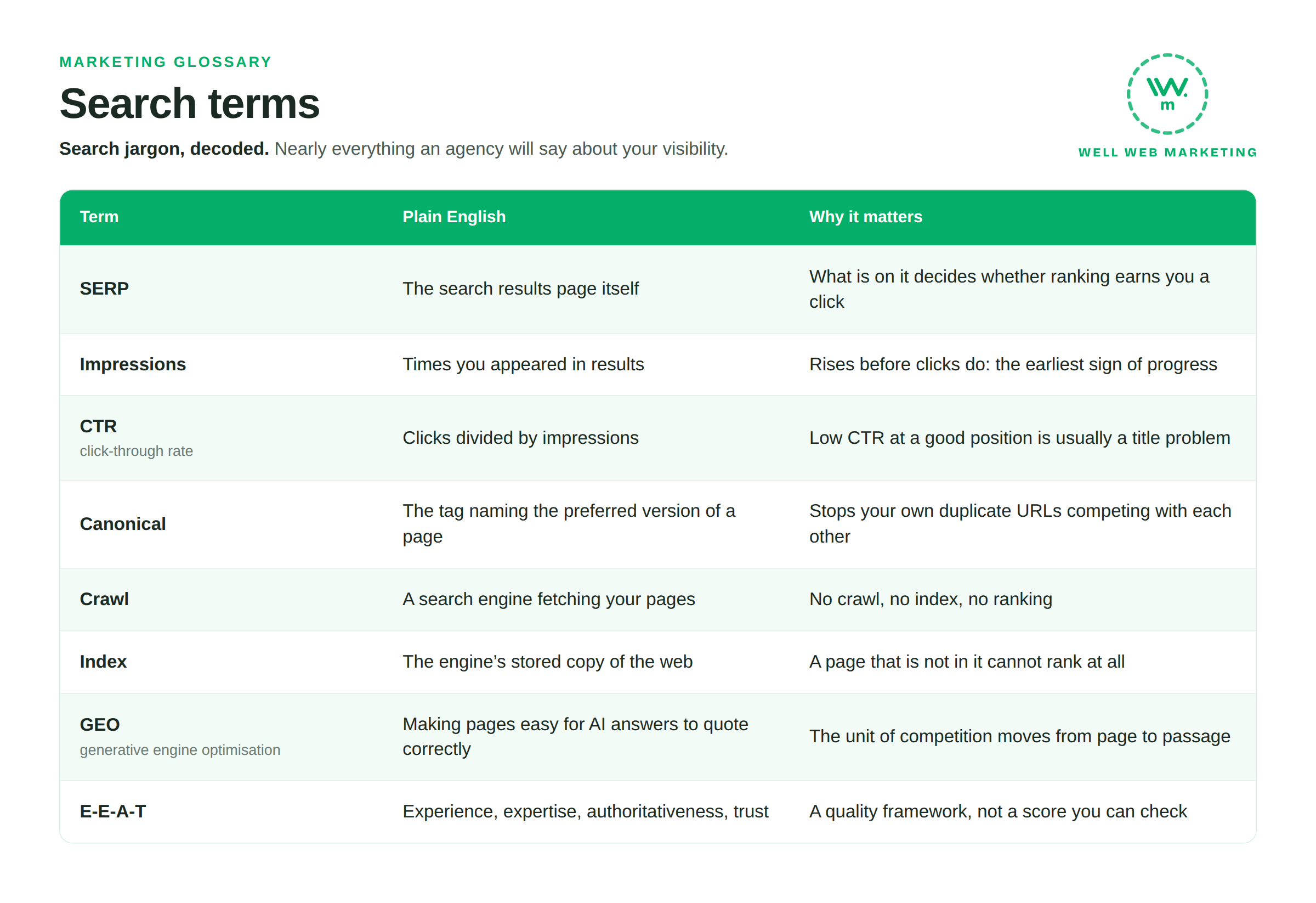
Search jargon is mostly descriptive once decoded. The words below cover nearly everything an agency will say about your visibility.
| Term | Plain English | Why it matters |
|---|---|---|
| SERP | The search results page itself | What is on it decides whether ranking earns you a click |
| Impressions | Times you appeared in results | Rises before clicks do: the earliest sign of progress |
| CTR (click-through rate) | Clicks divided by impressions | Low CTR at a good position is usually a title problem |
| Canonical | The tag naming the preferred version of a page | Stops your own duplicate URLs competing with each other |
| Crawl | A search engine fetching your pages | No crawl, no index, no ranking |
| Index | The engine’s stored copy of the web | A page that is not in it cannot rank at all |
| GEO (generative engine optimisation) | Making pages easy for AI answers to quote correctly | The unit of competition moves from page to passage |
| E-E-A-T | Experience, expertise, authoritativeness, trust | A quality framework, not a score you can check |
Click to download this table as an image
Advertising terms
Most advertising acronyms are simply a price with the unit attached. Once you know what you are being charged per, the rest follows.
| Term | Plain English | Why it matters |
|---|---|---|
| PPC (pay per click) | You pay when someone clicks | Cost scales with interest, not exposure |
| CPC (cost per click) | Price of one click | Set by competition for that search |
| CPM (cost per mille) | Price per thousand views | For awareness, where clicks are not the point |
| CPA (cost per acquisition) | Price of one conversion | The number to judge a campaign on |
| Impression share | Share of available views you won | Tells you whether budget or bid is the constraint |
| Negative keyword | A term you refuse to appear for | Where most wasted ad spend is eliminated |
| Retargeting | Ads shown to previous visitors | Cheap, effective, and easy to overdo |
Click to download this table as an image

Analytics terms
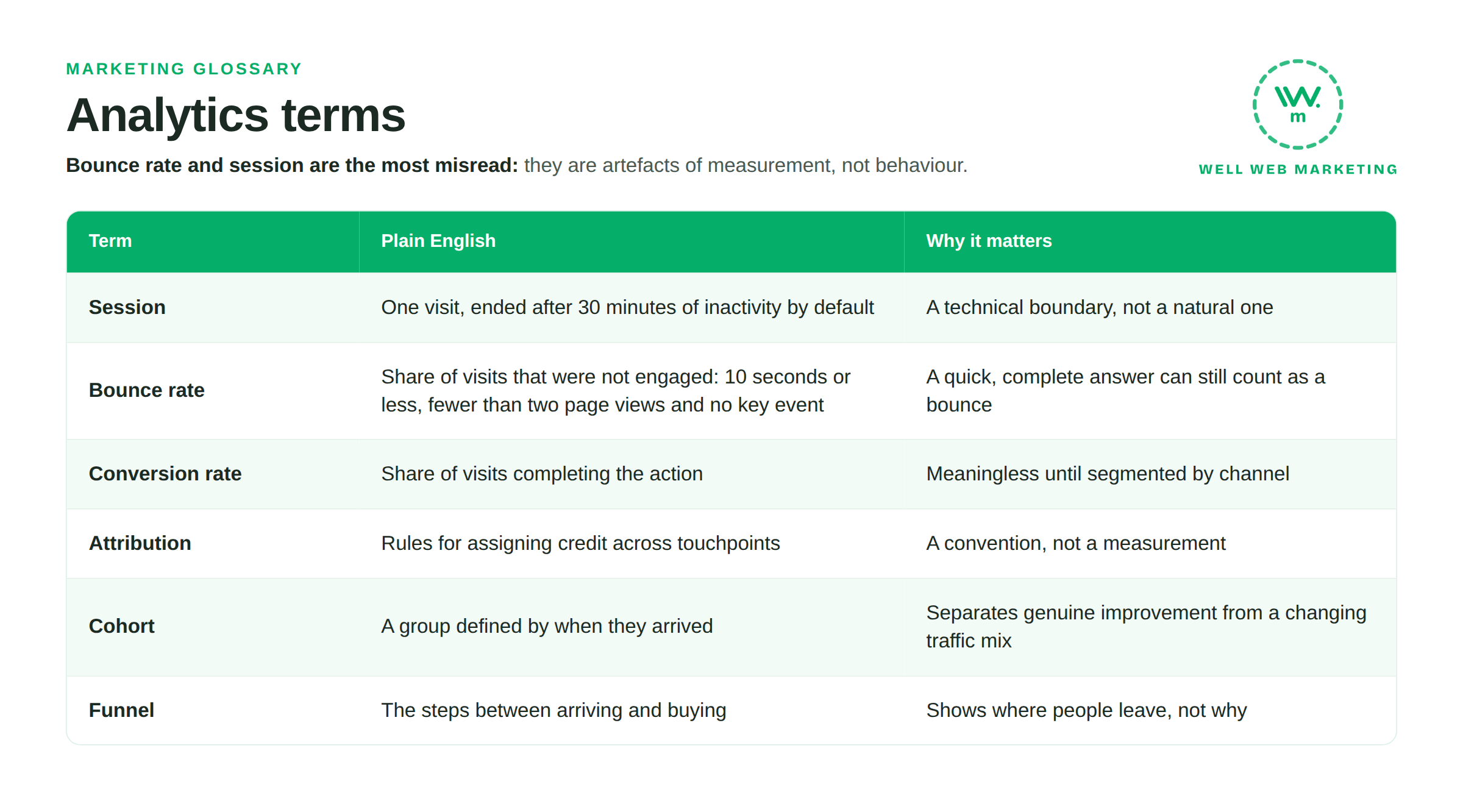
Two of the most quoted analytics terms are also the most misread. Bounce rate and session are both artefacts of measurement rather than descriptions of behaviour.
| Term | Plain English | Why it matters |
|---|---|---|
| Session | One visit, ended after 30 minutes of inactivity by default | A technical boundary, not a natural one |
| Bounce rate | Share of visits that were not engaged: 10 seconds or less, fewer than two page views and no key event | A quick, complete answer can still count as a bounce |
| Conversion rate | Share of visits completing the action | Meaningless until segmented by channel |
| Attribution | Rules for assigning credit across touchpoints | A convention, not a measurement |
| Cohort | A group defined by when they arrived | Separates genuine improvement from a changing traffic mix |
| Funnel | The steps between arriving and buying | Shows where people leave, not why |
Click to download this table as an image
Strategy terms
These are the vaguest terms in marketing and the ones most worth pinning down. Insist on a concrete answer whenever one is used about your business.
| Term | Plain English | Ask them |
|---|---|---|
| Positioning | Who you are the obvious choice for | Who does this exclude? |
| USP | The thing only you can credibly claim | Could a competitor say this too? |
| ICP (ideal customer profile) | The customer type you serve best | Which of our current customers is this based on? |
| Brand awareness | How many people know you exist | How will we know if it changed? |
| Top of funnel | People who do not yet know they need you | What happens to them next? |
| Growth hacking | Usually just marketing | What specifically do you mean? |
Click to download this table as an image

Jargon is often a way of describing a decision without having made it. Ask which decision the word stands for.
Serhii Yelbaiev, Well Web Marketing
Frequently asked questions
Start with the four money terms: CAC, LTV, the LTV:CAC ratio and payback period. Add conversion rate by channel to see where customers come from. Everything else is diagnostic detail you reach for when one of these moves.
Around three to one is the usual benchmark, meaning a customer is worth roughly three times what they cost to win. Lower is fragile; much higher often means you are underinvesting in growth.
Partly genuine variation between platforms, partly differentiation through vocabulary. Ask for the formula rather than the name and the differences usually disappear.
It is an extension of it. Classic SEO competes for a ranked link; generative engine optimisation competes to be the passage an AI answer quotes. The technical foundations are shared.
Sources and method
- Google Analytics Help: About Analytics sessions
- Google Analytics Help: Engagement rate and bounce rate
- Other definitions reflect standard industry usage across search, advertising and analytics platforms as of 2026. Benchmarks quoted are widely used conventions rather than measurements of any specific business. Last reviewed October 2026.