

A customer persona is a short, research-based profile of one type of customer: their goals, frustrations, buying triggers and the words they use. Download the free template below as a Word file or a fillable PDF, then use the filled-in B2B and B2C examples as a guide.
Key takeaways
- A customer persona describes one type of customer in enough detail that your team can write, sell and design for them.
- The template has 11 fields, from snapshot and goals to objections, channels and your key message.
- Human-centred design adds context, behaviours and a says, thinks, does and feels map.
- Base every field on evidence: interviews, reviews, sales calls and CRM data, not guesses.
- You can build a usable first persona in about 60 minutes if the research is already collected.
On this page
What is a customer persona?
A customer persona is a fictional but research-based character who represents a group of real customers with similar goals and problems. Software designer Alan Cooper introduced personas in his 1999 book The Inmates Are Running the Asylum, as a way to design for specific people instead of an imaginary “average user”. Marketing teams later adopted the idea as the buyer persona.
A persona is not the same as a segment. A segment groups customers by shared traits such as industry, size or location. A persona brings one segment to life, so a copywriter, a salesperson and a designer can all picture the same person. If you have not split your market yet, start with our guide to customer segmentation strategies.
The customer persona template, field by field
The best free buyer persona template is short enough to fill in one sitting and specific enough to change what you write. Ours has 11 fields. Each one below comes with what to write and the question to ask in customer interviews.
| Field | What to write | Question to ask |
|---|---|---|
| Snapshot | Name, role or life stage, age range, location, company size or household | Who is this, in one line? |
| Goals | What they want to achieve and what success looks like | What would make this a great year for them? |
| Frustrations | Problems, risks and annoyances with the current way | What wastes their time or money today? |
| Jobs to be done | “When ___, I want to ___, so I can ___.” | What job are they hiring a product for? |
| Context and behaviours | Where and when the problem happens, what they do now | What does a normal week look like? |
| Buying triggers | Events that start the search | What made them look for a solution now? |
| Objections | Doubts and fears that stop the purchase | Why might they say no? |
| Decision process | Who decides, who influences, budget and timeline | Who else has to agree? |
| Channels | Search, AI assistants, social, peers, events | Where do they look for answers? |
| In their words | One real quote from an interview or review | How do they describe the problem? |
| Our message | How you help, in one sentence, plus proof | Why should they choose us? |
Click to download this table as an image
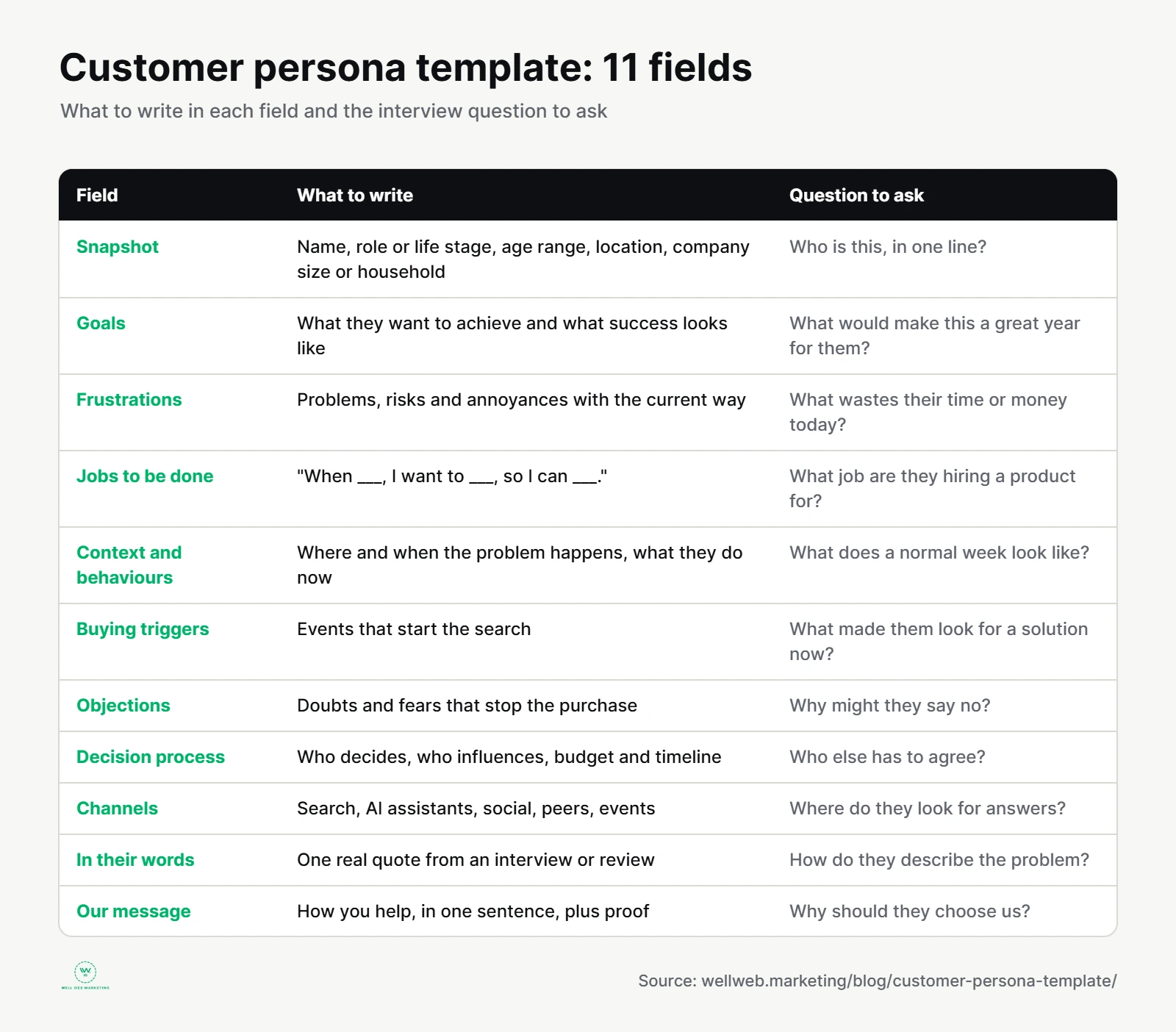
Keep demographics short. Age and job title rarely explain why someone buys; goals, triggers and objections do. If a field would not change a headline, an offer or a sales script, leave it out.
Customer persona examples: B2B and B2C
A filled-in customer persona example shows how specific each field should be. Both personas below are fictional composites, written the way we write them for clients.
| Field | B2B example: Priya | B2C example: Jake |
|---|---|---|
| Snapshot | Priya, 38, operations manager at a 60-person commercial cleaning company | Jake, 31, first-time homeowner with a 1970s house and a young family |
| Goals | Win more office contracts without hiring another salesperson | Keep the house warm and running costs predictable |
| Frustrations | Leads from directories are cheap but rarely convert | Quotes vary wildly and nobody explains the difference |
| Jobs to be done | When a contract ends, I want a full pipeline, so I can keep the team busy | When the boiler fails, I want it fixed today, so the kids are not cold |
| Buying triggers | Losing a large client; a new competitor in the area | A breakdown, a high energy bill, moving house |
| Objections | “Agencies promise leads and send us clicks” | “Will they turn up when they say they will?” |
| Decision process | Priya shortlists, the managing director signs off, 4–8 weeks | Jake and his partner decide together within a day or two |
| Channels | Google, LinkedIn, ChatGPT for comparisons, industry peers | Google Maps, reviews, local Facebook groups, friends |
| Our message | Qualified leads you can track to signed contracts | Same-day repair with a fixed price before we start |
Click to download this table as an image
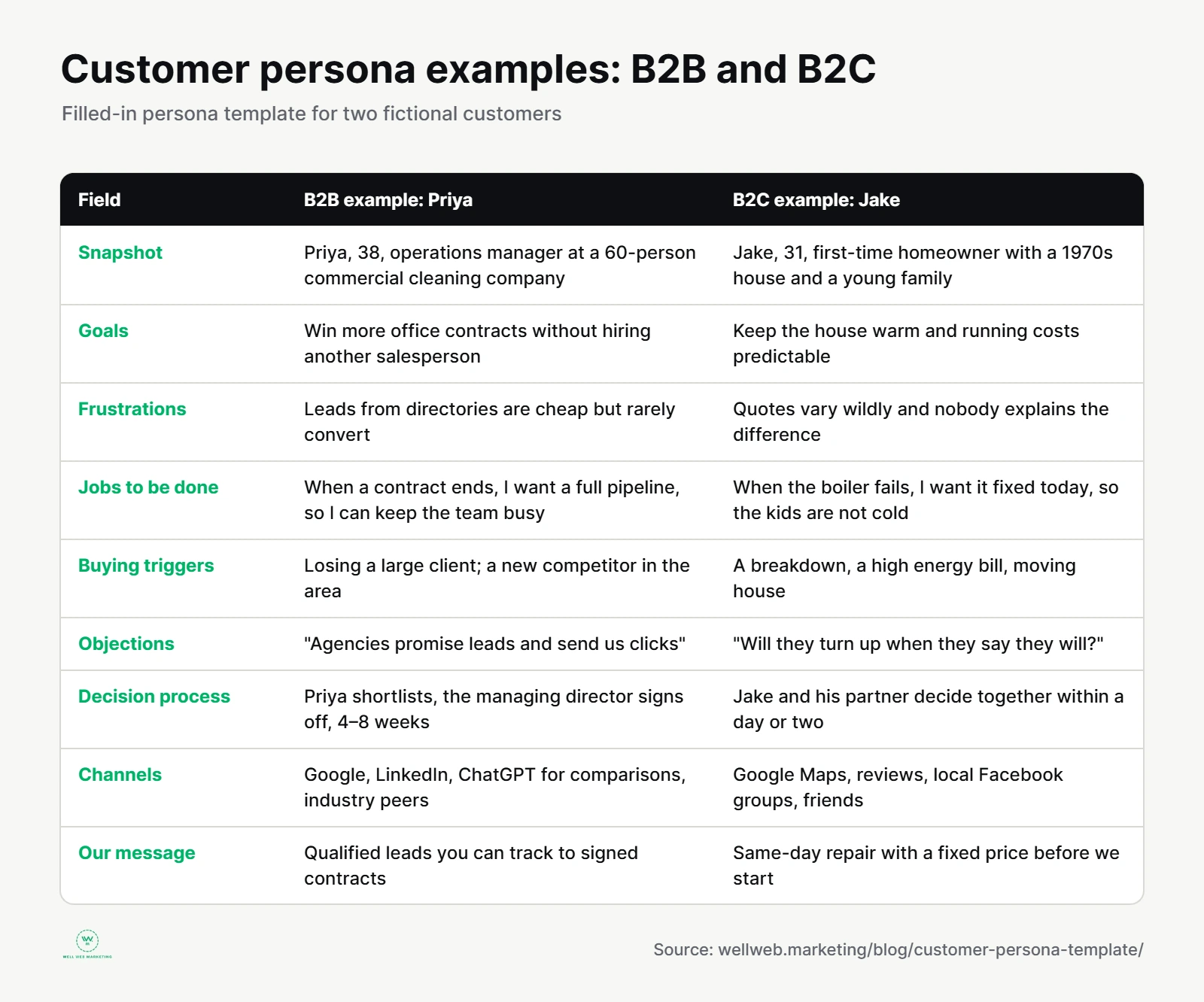
Notice that the B2B persona has a longer decision process and more people involved, while the B2C persona is driven by an urgent trigger. That difference changes everything downstream: Priya needs case studies and a clear way to track results, while Jake needs reviews, a visible price and a phone number above the fold. A UX and conversion review shows whether your site gives each persona what it needs. Our HVAC marketing case study shows what that looks like for an urgent home-services buyer.
Human-centred design fields
A customer persona template for human-centred design (HCD) adds fields about context and behaviour, not only about buying. HCD starts from the people you serve and what they actually do, an approach popularised by IDEO.org’s The Field Guide to Human-Centered Design (2015). Add these fields when the persona will guide product, service or website design:
- Context of use. Where, when and on which device they meet the problem: on a job site, on a phone, between meetings.
- Current behaviours. What they do today, including workarounds such as spreadsheets, phone calls or asking a friend.
- Says and thinks. What they say out loud in interviews, and what they worry about but may not say.
- Does and feels. The actions you can observe, and the emotions behind them: stress, doubt, relief.
- Accessibility needs. Anything that affects how they read, hear or use your site.
The says, thinks, does and feels quadrant is known as an empathy map, a tool created by Dave Gray at XPLANE. Use direct quotes in “says” and keep your interpretation for “thinks” and “feels”.
A persona earns its place when the sales team recognises the customer in it. If they say “nobody talks like that”, go back to the interviews.
Serhii Yelbaiev, Well Web Marketing
How to build a persona in 60 minutes
You can build a first persona in about an hour if you collect the evidence before the session. Ask sales and support for call notes, export reviews and pull the top search queries from Search Console beforehand.
- Minutes 0–10: review the evidence. Read five to ten customer interviews, reviews or call notes for one segment.
- Minutes 10–25: find the patterns. Write repeated goals, problems and phrases on sticky notes and group them.
- Minutes 25–40: fill in the template. Work through the 11 fields. Use the customers’ own words wherever you can.
- Minutes 40–50: check it with the front line. Ask someone from sales or support what is wrong or missing.
- Minutes 50–60: write the message. Agree one sentence on how you help this persona, then share the document with the team.
Nielsen Norman Group calls a persona built mostly from assumptions a lightweight or proto-persona. That is a fine starting point, as long as you replace guesses with research over time. Personas also help with AI search: assistants answer the questions your customers ask, so the persona’s questions are a ready-made prompt list for AI visibility tracking.
Frequently asked questions
A useful template includes a snapshot, goals, frustrations, jobs to be done, context and behaviours, buying triggers, objections, decision process, channels, a real customer quote and your key message for that persona.
The best template is one your team will actually fill in and use. Ours has 11 fields, comes as a Word file or a fillable PDF, and includes filled-in B2B and B2C examples.
The terms are mostly used as synonyms. Buyer persona usually stresses the purchase decision, while customer or user persona can also cover how people use the product after they buy.
Most small and medium businesses need two to four. Start with the persona that brings the most revenue, then add others only when they need different messages or offers.
In human-centred design, a persona focuses on context, behaviours and feelings as well as goals. It often includes an empathy map of what the person says, thinks, does and feels.
Review personas at least once a year, and sooner when you launch a new product, enter a new market or see a clear change in who buys from you.
Want personas built from real customer data? Start with an SEO and AI-search audit or book a call with Well Web Marketing.
Sources and method
- Alan Cooper, The Inmates Are Running the Asylum, Sams, 1999.
- IDEO.org, The Field Guide to Human-Centered Design, 2015.
- Nielsen Norman Group, 3 Persona Types: Lightweight, Qualitative, and Statistical.
- Dave Gray, empathy map, XPLANE.
- The B2B and B2C personas are fictional composites based on the kinds of clients we work with. Last reviewed October 2026.