
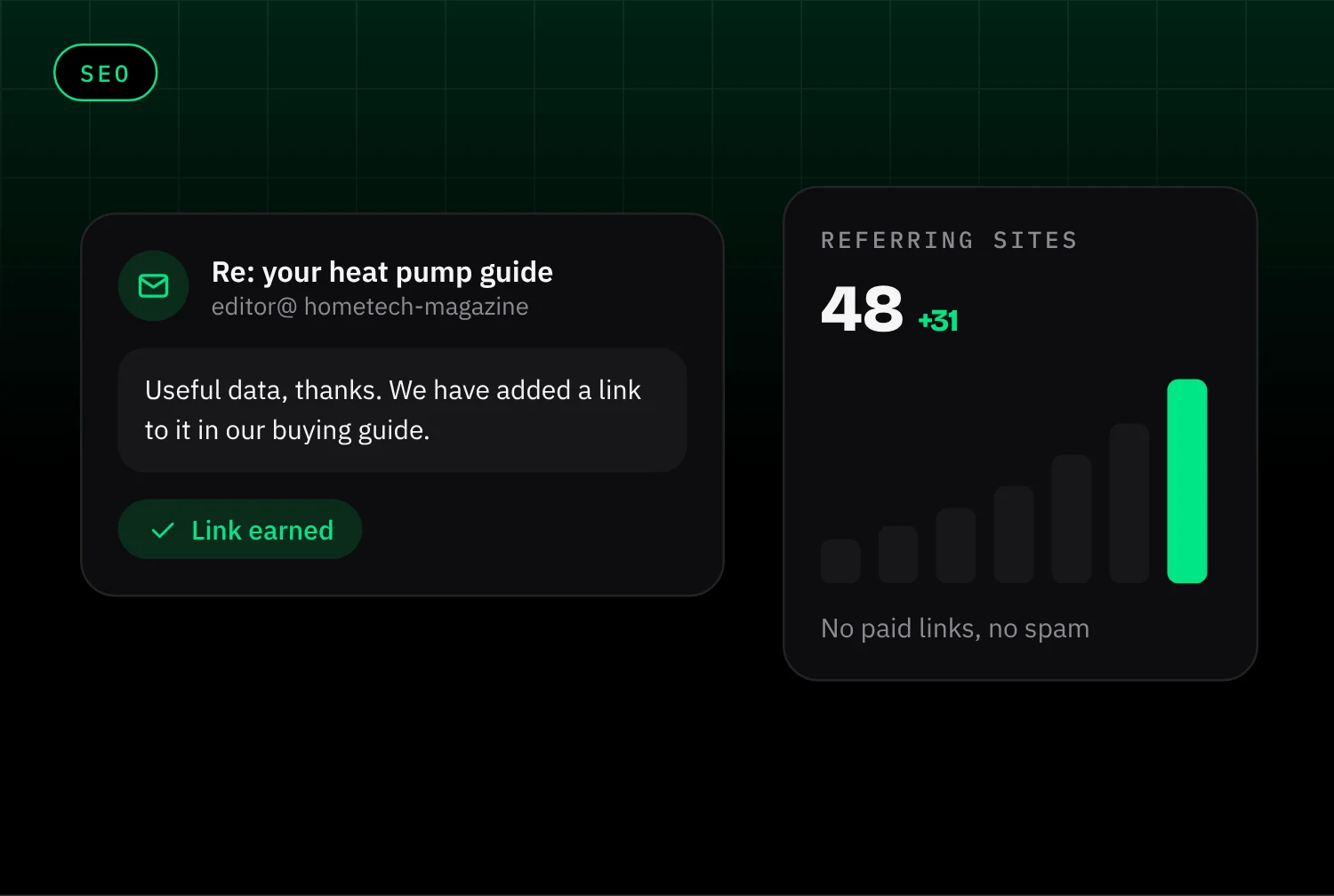
Most of what gets sold as link building is either inert or actively risky. A smaller set of things still works, and it looks much more like public relations than like SEO.
Key takeaways
- One relevant link from a site your customers read beats fifty from directories nobody visits.
- Paid links, guest post networks and excessive link swaps are named in Google’s spam policies: at best they waste budget, at worst they lead to a manual action.
- Links follow assets. Publish something worth referencing before you start asking anyone to reference you.
- Relevance and traffic predict value far better than any third-party authority score.
On this page
What a link is actually signalling
A link is a citation: evidence that someone independent thought your page was worth pointing at. Every rule that follows is downstream of that. Once you treat links as evidence rather than currency, most tactics sort themselves into useful or absurd.
It also explains why volume stopped working. A thousand citations from sources with no readers is not evidence of anything, and search engines worked that out a long time ago.
What still works
The durable tactics all involve giving someone a genuine reason to mention you. They are slower and they do not scale neatly, which is exactly why they retain value.
- Original data. A survey, a benchmark, an analysis of your own anonymised numbers. Journalists and bloggers need figures to cite, and there are never enough of them.
- Genuinely useful free tools. A calculator or checker that solves one narrow problem can earn links for years with little ongoing effort, once it has been promoted at launch and its data is kept current.
- Digital PR. A real story offered to people who cover your sector. This is the highest-value channel and the one most agencies avoid because it can fail.
- Being the definitive reference. The most complete, best-maintained page on a specific topic accumulates links passively. A clear content strategy decides which topics deserve that page, and our Content Engine helps keep it maintained.
- Existing relationships. Suppliers, partners, clients, trade bodies, sponsorships, the local chamber. Unglamorous, relevant, and usually free.
- Consistent local citations. A separate job from links: your name, address and phone listed the same way across directories and local sites. Consistent local citations support local rankings alongside your Google Business Profile; our local SEO and Google Business Profile package covers both.
- Mentions that AI answers can find. Links and brand mentions on trusted sites appear to influence which businesses AI Overviews and ChatGPT cite. The evidence so far is correlational and the platforms have not described the mechanism, but the sites they cite tend to be the ones others reference. See how to get cited in AI answers, or let our AI Visibility Boost do the groundwork.
What stopped working
Anything that can be bought at volume has already been devalued. The mechanism is simple: if a link can be acquired without a judgement being made, it carries no judgement.
| Tactic | Value now | Why |
|---|---|---|
| General web directories | Inert | No editorial judgement, no readers |
| Paid link placements | Risky | Violates guidelines unless marked rel="sponsored" |
| Guest post networks | Risky | Usually paid, so effectively bought links; large-scale guest posting is named in Google’s spam policies |
| Comment and forum drops | Inert | Almost universally nofollowed and ignored |
| Reciprocal link swaps | Inert to risky | Obvious in the link graph; excessive link exchanges are named in Google’s spam policies |
| Niche industry directories | Modest | Real relevance, occasionally real traffic |
Click to download this table as an image

Paying for a placement is allowed if the link is marked rel="sponsored"; such a link generally isn’t expected to pass ranking value, because Google treats sponsored, nofollow and ugc as hints rather than strict rules. The risk comes from hiding the payment.
For most small sites the bigger risk is not a manual penalty, although those still happen. It is spending a year of budget on links that were never going to do anything, and having no way to tell because rankings drifted for unrelated reasons.
How to judge a link before chasing it
Ask whether a relevant human being would plausibly click it. That single question filters out most bad opportunities faster than any metric.
- Relevance. Is this site about anything close to what you do? A link from an unrelated high-authority site is worth less than a relevant modest one.
- Real audience. Does the site have traffic, subscribers, social presence? Check whether it ranks for anything itself.
- Editorial standards. Does it publish anything from anyone? If the answer is yes, the link means nothing.
- Placement. In the body of a relevant article, not in a footer, sidebar or author box.
- Context. Surrounding text that describes what you do, with anchor text that reads naturally.
Treat third-party authority scores as a rough filter and nothing more. They are models of a signal, not the signal, and they are trivially inflated by anyone selling links.
If you would be pleased to see the link even if it passed no ranking value at all, it is probably a good link.
Serhii Yelbaiev, Well Web Marketing
Outreach that gets a reply
The reply rate on outreach is set almost entirely by whether you are offering something or asking for something. Templates fail because they are transparently the latter.
What works is short, specific and evidently written by someone who read the page. Name the article. Say precisely what you have that would improve it: a figure, a diagram, a correction. Make it easy to say yes and easy to ignore. Send one follow-up, never three.
Cold, templated outreach rarely gets more than a few replies in a hundred. Personalised pitches that offer something real often do several times better, commonly 5 to 15%. Either way, the reply rate is decided by the asset, which is why the asset has to come first.
Frequently asked questions
There is no threshold. Look at what currently ranks for your target term: if those pages have a handful of relevant references, you need something comparable, not a campaign. Links also only help once the basics are in place, which is why they come late in SEO foundations; an SEO and AI-search audit shows where you stand.
No. They still bring traffic, awareness and often a followed link later from someone who found you through them. Treating nofollow as worthless is a habit left over from an older, simpler model.
Almost never. Search engines ignore most low-quality links automatically, and careless disavowing removes value you were benefiting from. Reserve it for a confirmed manual action.
Not in a way that is worth the exposure. Beyond the guideline violation, purchased links sit on sites with no audience, so even discounting the risk you are paying for something inert.
Sources and method
- Google Search Central, Spam policies for Google web search (link spam)
- Google Search Central, Qualify your outbound links (
rel="sponsored",rel="ugc"andrel="nofollow") - Google Search Console Help, Disavow links to your site
- Reflects our own outreach and digital PR work for small and medium clients. Last reviewed October 2026.