

Being visibly mediocre on six platforms is worse than being genuinely good on two. Most small businesses spread themselves across everything and get nothing back from any of it.
Key takeaways
- Choose platforms by where your buyers already are and what format you can sustain, not by audience size.
- Organic reach on most platforms is now low enough that social works best as proof and distribution, not acquisition.
- Repurposing one substantial idea across formats beats inventing something new every day.
- Followers are not the goal. Enquiries, saves and shares tell you far more.
On this page
Choosing which two
The right platform is the intersection of where your buyers spend time and which format you can produce well every week. Both halves matter; a perfect audience match on a format you hate will be abandoned by March.
| Platform | Fits | Format you must sustain |
|---|---|---|
| B2B, services, recruiting | Written posts, opinion, case detail | |
| Visual products, local, lifestyle | Photography, short video | |
| YouTube | Considered purchases, teaching | Long-form video, high effort |
| TikTok | Consumer, younger audiences | Frequent short video, on-camera |
| Local services, communities, older demographics | Posts, groups, events |
Click to download this table as an image

Be honest about the format column. Video-first platforms punish inconsistency severely, and “we will start doing video” is the most commonly broken marketing promise there is. For B2B, LinkedIn is usually the one worth the effort; our LinkedIn B2B Lead Engine turns it into a steady source of conversations.
Are Bluesky and Threads worth it?
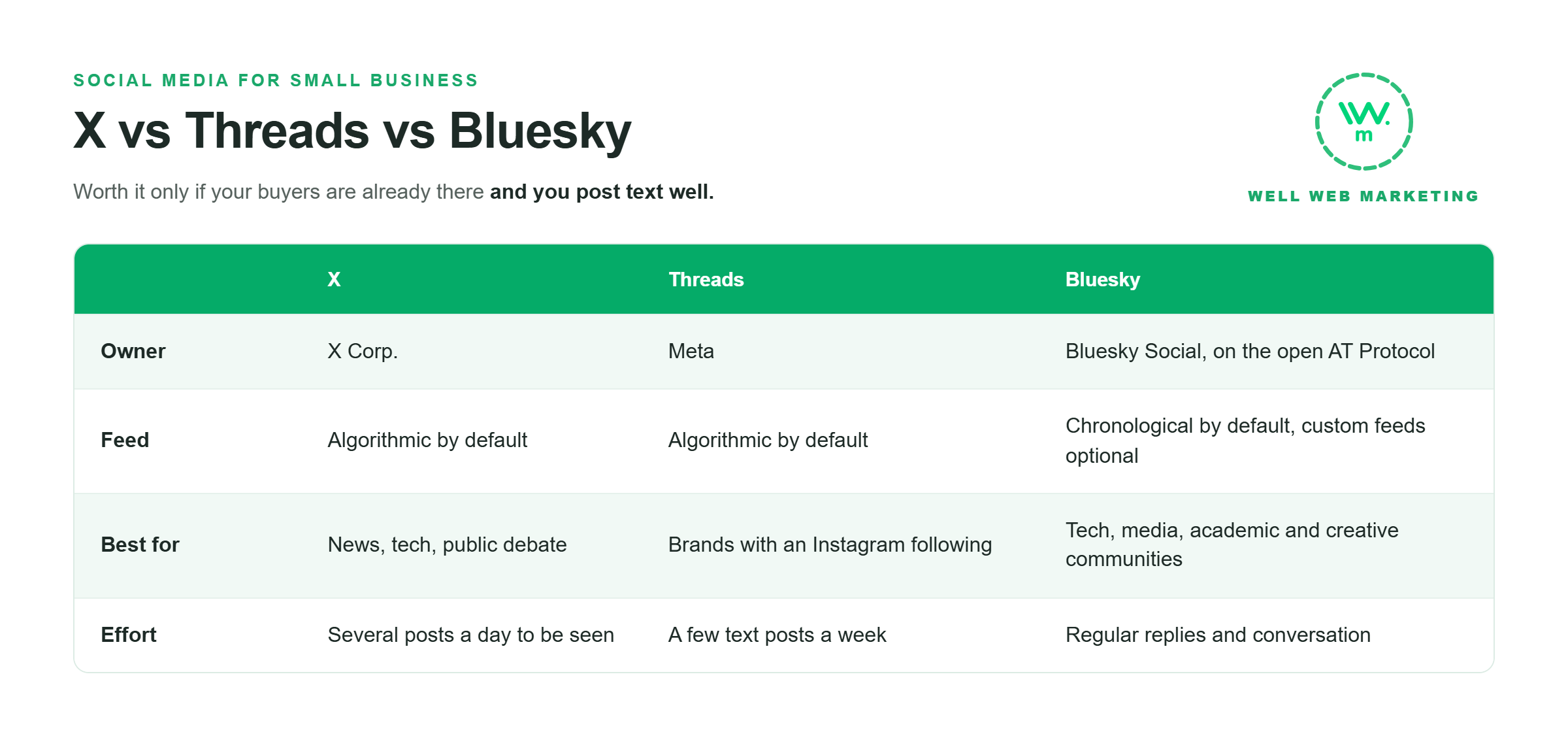
Only if your buyers are already there and you post text well. Bluesky is an open, decentralised alternative to X: a chronological, conversation-first network with no algorithm deciding who sees your posts by default. Threads is Meta’s text network, usually linked to your Instagram account (though you can now sign up without one in many regions), so it suits brands that already have an Instagram audience.
| X | Threads | Bluesky | |
|---|---|---|---|
| Owner | X Corp. | Meta | Bluesky Social, on the open AT Protocol |
| Feed | Algorithmic by default | Algorithmic by default | Chronological by default, custom feeds optional |
| Best for | News, tech, public debate | Brands with an Instagram following | Tech, media, academic and creative communities |
| Effort | Several posts a day to be seen | A few text posts a week | Regular replies and conversation |
Click to download this table as an image
Whichever two you pick, get the images right from day one. Our social media image sizes guide lists every size in one table.
What social is actually for now
Organic reach on most platforms is low enough that social is better understood as proof and distribution than as an acquisition channel. Expecting it to generate leads directly is how most small-business social accounts end up abandoned.
It does three things well. It gives someone who already heard your name a way to check you are real and active. It distributes work you produced elsewhere to people who already follow you. And it is where conversations happen that occasionally turn into business, on a timescale nobody can attribute.
Judged against those three jobs, a modest, consistent presence is a success. Judged as a lead generator, the same account looks like a failure. The account did not change; the expectation did.
One idea, several formats
The sustainable model is to have one substantial idea a week and express it in several places, rather than to invent something new every day. Daily original ideation is what burns out small teams within two months.
- Start with something you actually did: a client problem, a result, a mistake, a decision you had to argue for.
- Write it properly once, at whatever length it needs, ideally as a page that fits your content strategy.
- Pull the single most surprising sentence out as a standalone post.
- Turn any comparison or process into a simple graphic or short video. If design is the bottleneck, an Ad Creatives Pack or a Motion & Video Ads Pack gives you templates to reuse.
- Answer the questions people ask in the comments as their own posts the following week.
This also solves the quality problem. Five posts derived from one real experience are all specific; five posts invented on five separate mornings are all generic.
If the constraint is production rather than ideas, our social media starter sets up the accounts, templates and a workable posting rhythm so the habit survives the first quarter.
Measuring without fooling yourself
Follower count is the least informative number on the dashboard. Saves, shares and profile visits indicate genuine interest; likes indicate that something scrolled past pleasantly.
Watch saves and shares as a quality signal, profile visits and link clicks as an intent signal, and direct messages or enquiries mentioning social as the only real conversion signal. Add a source field to your enquiry form, social’s contribution is routinely invisible in analytics and routinely visible when you simply ask. Our guide to attribution models explains why.
Social media rarely closes the sale. It very often decides whether you were on the shortlist.
Serhii Yelbaiev, Well Web Marketing
Making it survive contact with a busy month
Set the frequency you can hold during your worst month, not your best. Consistency at twice a week beats daily for six weeks followed by silence.
- Batch production. One session a fortnight beats a scramble every morning.
- Keep a running list of ideas as they occur during client work, the blank page is the real enemy.
- Reply to comments properly. Conversation is weighted heavily by every platform and costs nothing.
- Do not automate replies or comments. It is obvious, and it undoes the trust the posting was building.
- Review the choice of platforms once a year, not once a quarter.
Frequently asked questions
Two, done properly. A third only once the first two run without conscious effort, which usually takes a year.
Boosting is a poor substitute for a properly targeted campaign. If you have budget, run a real campaign with a defined audience and objective instead. The Meta Ads Launch Pack sets one up for Facebook and Instagram.
Whatever you can sustain indefinitely. Two considered posts a week held for a year beats daily posting abandoned in March.
Not directly, social links are typically nofollowed. It helps indirectly by putting work in front of people who may then reference it from somewhere that does count. That is the same logic as link building without the spam.
Sources and method
- Bluesky, The AT Protocol (how Bluesky’s open network and custom feeds work)
- Open Terms Archive, Threads expands profile creation beyond Instagram users (May 2025)
- Platform fit and measurement observations come from our own work with small and medium clients across B2B and consumer sectors. Last reviewed October 2026.