
A positioning strategy is the choice of one idea your brand will own in the customer’s mind, and the reason they should believe it. There are ten common types, from attribute and benefit positioning to price, competitor and problem-solution positioning. Below, each type gets a real example, plus how to choose one and turn it into a positioning statement.
Key takeaways
- A positioning strategy picks one idea to own, such as safety, speed or low price, and makes every marketing decision support it.
- The ten common types are attribute, benefit, price, quality, use, user, competitor, category, problem-solution and cultural symbol positioning.
- External positioning is what the market believes about you. Internal positioning is whether your own team can explain and deliver it.
- Your competitive posture (leader, challenger, follower or nicher) limits which types are realistic for you.
- The ten types are still current in 2026: Apple, Liquid Death, Patagonia and Perplexity have all built recent positions on them.
- Write the result as a one-paragraph positioning statement before you write any ads or web copy.
On this page
- What is a positioning strategy?
- 10 types of positioning strategies
- Are these types still relevant in 2026?
- Internal vs external positioning
- Brand vs market vs product positioning
- Competitive postures: leader, challenger, follower, nicher
- How to choose a positioning strategy
- Positioning statement: template and example
- Frequently asked questions
- Sources and method
What is a positioning strategy?
A positioning strategy is a deliberate decision about the single place your brand should hold in customers’ minds compared with the alternatives they already know. Al Ries and Jack Trout made the idea famous in their 1981 book Positioning: The Battle for Your Mind. Their point was that positioning is not something you do to a product. It is something you do to the mind of the prospect.
In practice, a positioning strategy answers three questions: who the brand is for, what it should be known for, and why customers should believe it. Everything else follows from those answers: pricing, product features, the words on your homepage and the channels you buy. If you want the wider picture first, our guide to marketing positioning explains why it is the decision every other marketing decision depends on.
10 types of positioning strategies with examples
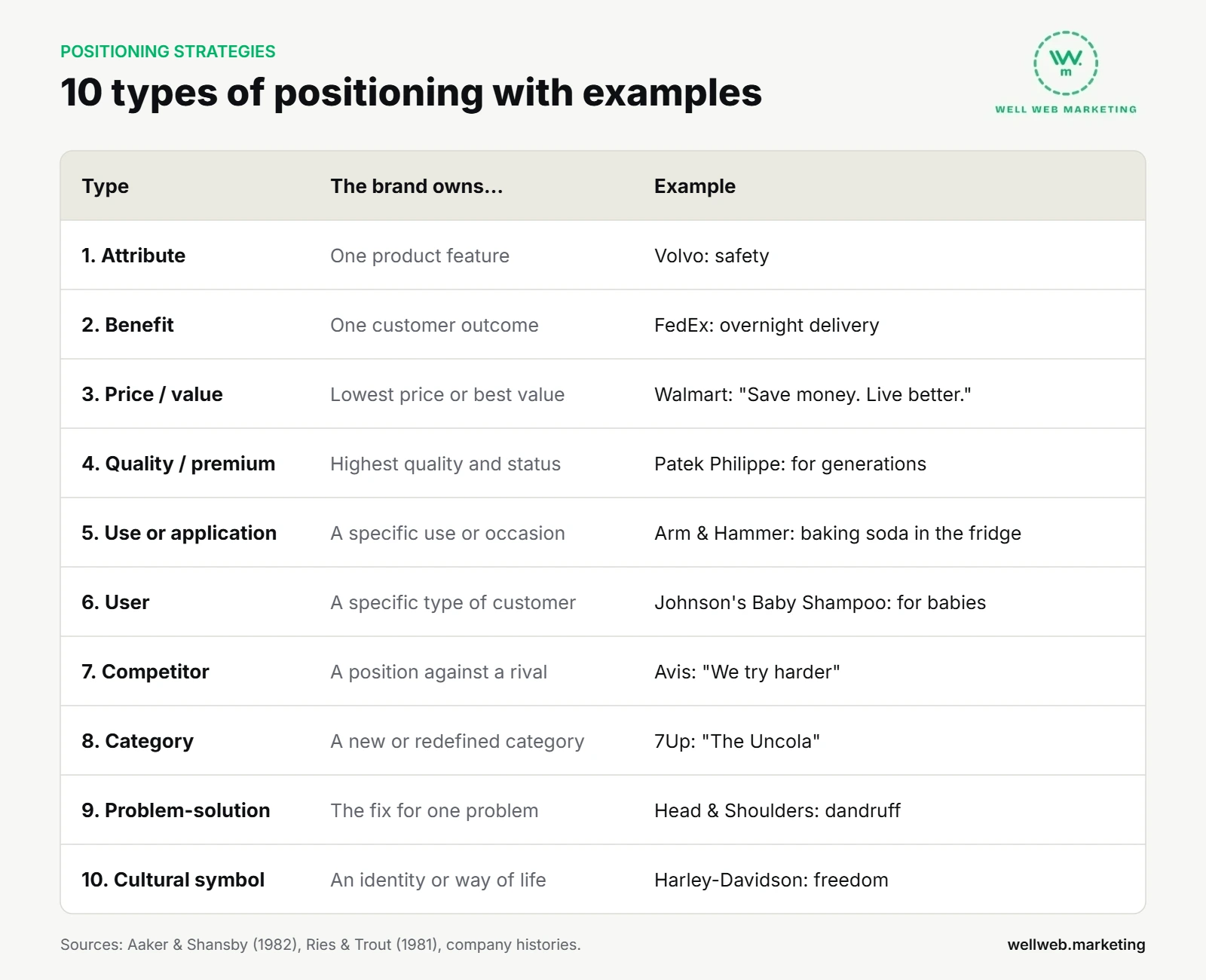
Most positioning strategies fall into ten types, each built around a different reason to choose you. Six of them come from David Aaker and J. Gary Shansby’s 1982 article in Business Horizons: attribute, price-quality, use, user, product class and competitor positioning. Aaker added cultural symbols in his 1991 book Managing Brand Equity, and benefit and problem-solution positioning have since become just as common.
| Type | The brand owns… | Example |
|---|---|---|
| Attribute | One product feature | Volvo: safety |
| Benefit | One outcome for the customer | FedEx: overnight delivery you can rely on |
| Price / value | The lowest price or best value | Walmart: “Save money. Live better.” |
| Quality / premium | The highest quality and status | Patek Philippe: a watch for generations |
| Use or application | A specific use or occasion | Arm & Hammer: baking soda in the fridge |
| User | A specific type of customer | Johnson’s Baby Shampoo: for babies |
| Competitor | A position against a named rival | Avis: “We try harder” |
| Category | A new or redefined category | 7Up: “The Uncola” |
| Problem-solution | The fix for one problem | Head & Shoulders: dandruff |
| Cultural symbol | An identity or way of life | Harley-Davidson: freedom of the open road |
Click to download this table as an image
1. Attribute positioning
Attribute positioning ties the brand to one product feature. Volvo has owned safety for decades: its engineer Nils Bohlin developed the three-point seatbelt in 1959, and Volvo opened the patent to other carmakers. The risk is that features can be copied, so the attribute needs proof that competitors cannot easily match.
2. Benefit positioning
Benefit positioning sells the outcome rather than the feature. FedEx’s 1978–1983 campaign “When it absolutely, positively has to be there overnight” did not talk about planes or sorting hubs. It promised peace of mind for anyone who could not afford a late delivery.
3. Price or value positioning
Price positioning claims the lowest price or the best value for money. Walmart’s slogan “Save money. Live better.”, introduced in 2007, links low prices to a better life rather than to cheapness. This type only works if your cost structure lets you hold the price when a rival cuts theirs.
4. Quality or premium positioning
Premium positioning is the opposite end of the price scale: the brand stands for the best, and the price is part of the proof. Patek Philippe’s “Generations” campaign, running since 1996, says “You never actually own a Patek Philippe. You merely look after it for the next generation.”
5. Use or application positioning
Use positioning links the product to a specific use or occasion. In 1972 Arm & Hammer started promoting its baking soda as a fridge deodoriser, giving an old product a new everyday job and a new reason to buy it again.
6. User positioning
User positioning builds the brand around one type of customer. Johnson’s Baby Shampoo, with its “No More Tears” formula introduced in 1953, is positioned for babies. That focus also made it appealing to adults who wanted something gentle.
7. Competitor positioning
Competitor positioning defines the brand against a named rival. In 1962 Avis admitted it was number two in car rental behind Hertz and turned that into a promise: “We try harder.” Competitor positioning works best when the market already knows the leader, so your message borrows its fame.
8. Category positioning
Category positioning moves the brand into a new or redefined category where it can be first. 7Up’s 1968 “Uncola” campaign stopped competing as one more soft drink and positioned 7Up as the alternative to every cola.
9. Problem-solution positioning
Problem-solution positioning makes the brand the default fix for one problem. Procter & Gamble launched Head & Shoulders in 1961 as an anti-dandruff treatment, and it is still the brand many people name first when they think of dandruff. This type suits service businesses well: a plumber who fixes leaks the same day owns a problem, not a feature.
10. Cultural symbol positioning
Cultural symbol positioning attaches the brand to an identity or way of life. Harley-Davidson sells freedom and independence more than motorcycles, and it built a community around that idea with the Harley Owners Group, launched in 1983. This is the hardest type to build and the hardest for competitors to copy.
Are these positioning types still relevant in 2026?
Yes. The ten types still describe how buyers choose between brands in 2026; what has changed is where a position gets tested. Most of the examples above are decades old because they have had time to prove themselves. Brands launched or repositioned in the last few years use the same playbook:
- Attribute: Apple. Since CES in January 2019, Apple has run “Privacy. That’s iPhone.” to make privacy a feature of the phone, not a policy page.
- Category: Liquid Death. It started selling canned water online in January 2019 with the line “Murder your thirst”, moving water out of the commodity aisle and into lifestyle drinks.
- Cultural symbol: Patagonia. In September 2022 its founder transferred ownership of the company to a trust and a non-profit and announced “Earth is now our only shareholder”, turning its environmental stance into the brand itself.
- Category and competitor: Perplexity. Launched in late 2022, it calls itself an answer engine rather than a search engine, a position defined directly against Google.
The bigger change in 2026 is the channel. AI assistants such as ChatGPT, Gemini and Microsoft Copilot now summarise brands for buyers, and a brand with one clear, consistently repeated position is easier for them to describe and recommend. Our guide to getting cited in AI answers explains how to check what they say about you.
Internal vs external positioning
External positioning is how customers and the market see your brand. Internal positioning is how well your own people understand that position and act on it. An external market positioning strategy covers your target segment, your message, your price and your channels. The internal side covers sales scripts, onboarding, service standards and what your support team says when something goes wrong.
The two have to match. A brand that claims premium service but answers support tickets in three days loses its position faster than any competitor could take it. Before you launch a new position, check that the people who deliver it can explain it in one sentence.
Brand vs market vs product positioning
Brand, market and product positioning work at different levels, and most businesses need all three to point the same way.
| Level | Question it answers | Example |
|---|---|---|
| Brand positioning | What does the company stand for overall? | Volvo stands for safety across every model. |
| Market positioning | Which segment do we compete in, and where in it? | A budget airline competes on price within short-haul travel. |
| Product positioning | Why choose this product over the alternatives? | A family SUV positioned on crash-test results and space. |
Types of brand positioning use the same ten approaches as product positioning, but they apply to the whole company. Market positioning depends on how you split the market first, which is why it starts with a clear customer segmentation strategy.
Competitive postures: leader, challenger, follower, nicher
Your competitive posture is your role in the market, and it decides which positioning options are realistic. Philip Kotler describes four postures. In posture marketing, the question is not only which idea you want to own, but which idea your market share and budget let you defend.
- Leader. Holds the largest share. Leaders usually position on category ownership or quality and defend the market as a whole.
- Challenger. Attacks the leader for share. Competitor and benefit positioning fit best, as Avis showed against Hertz.
- Follower. Copies what works and competes on price or convenience without starting a fight with the leader.
- Nicher. Serves one segment better than anyone else. User, use and problem-solution positioning are the natural fit, and this is where most small and medium businesses should start.
A small business rarely wins by sounding like the market leader. It wins by owning one problem, for one type of customer, better than anyone else.
Serhii Yelbaiev, Well Web Marketing
How to choose a positioning strategy in 5 steps
Choose a positioning strategy by matching what your customers value with what you can prove and your competitors cannot claim.
- Pick the segment. Decide who you are positioning for. A position that tries to please everyone ends up owning nothing.
- List what that segment values. Use reviews, sales calls and search queries, not internal opinions. Write down the words customers actually use.
- Map the competitors. Note the position each main competitor already holds. The open spaces on that map are your positioning options.
- Match a type to your proof. Choose the type from the table above that you can back with evidence: a feature, a result, a price or a customer group you already serve best.
- Test before you commit. Try the new position in ads, a dedicated landing page or sales emails and compare response rates before you rebuild the brand around it.
If you need help with step 3, our SEO and AI-search audit shows how search engines and AI assistants currently describe you and your competitors, which is a fast way to see the positions already taken.
Positioning statement: template and example
A positioning statement turns your chosen strategy into one internal paragraph that every team can use. The most widely used template comes from Geoffrey Moore’s Crossing the Chasm:
For [target customer] who [need or problem], [brand or product] is a [category] that [key benefit]. Unlike [main alternative], we [main point of difference].
Positioning statement template, after Geoffrey Moore
Here is an example for a fictional local business using problem-solution positioning:
For homeowners in Leeds whose boiler breaks down in winter, QuickHeat is a heating repair service that restores heat the same day. Unlike national repair networks, we keep our own engineers within 30 minutes of every postcode we serve.
The statement is not a slogan and is rarely published as written. It is a test: every headline, offer and visual you create later should be traceable back to it. When you turn it into a visual identity, our brand and logo identity work starts from exactly this paragraph.
Frequently asked questions
The ten common types are attribute, benefit, price or value, quality or premium, use or application, user, competitor, category, problem-solution and cultural symbol positioning. Most brands lead with one type and use one or two others as support.
In his 1996 Harvard Business Review article “What Is Strategy?”, Michael Porter describes three sources of strategic positioning: variety-based (a focused range of products or services), needs-based (serving most needs of one customer group) and access-based (serving customers who are reached in a different way, for example by location or size).
Volvo is a classic example of attribute positioning: it has built its brand around safety since the three-point seatbelt of 1959. Avis is a classic example of competitor positioning: in 1962 it used its number-two status behind Hertz to promise that it tries harder.
Philip Kotler’s four competitive postures are leader, challenger, follower and nicher. Leaders defend the whole market, challengers attack the leader, followers copy what works at lower cost, and nichers serve one segment better than anyone else.
Brand positioning describes what the whole company stands for in customers’ minds. Market positioning describes which segment you compete in and where you sit within it, for example the budget end of short-haul travel.
Segmentation splits the market into groups of customers with similar needs. Positioning comes next: it decides which of those groups you serve and what idea you want them to associate with your brand.
Not sure which position you can own? Start with an SEO and AI-search audit or book a call with Well Web Marketing.
Sources and method
- Al Ries and Jack Trout, Positioning: The Battle for Your Mind, McGraw-Hill, 1981.
- David A. Aaker and J. Gary Shansby, “Positioning Your Product”, Business Horizons, 1982.
- Philip Kotler and Kevin Lane Keller, Marketing Management, 16th edition, Pearson, 2022: competitive strategies for market leaders, challengers, followers and nichers.
- David A. Aaker, Managing Brand Equity, Free Press, 1991: cultural symbol positioning.
- Geoffrey A. Moore, Crossing the Chasm, HarperBusiness, 1991: positioning statement template.
- Brand examples were checked against company histories and published campaign records, including WARC, the official brand histories of Arm & Hammer (Church & Dwight) and Head & Shoulders (P&G). Last reviewed October 2026.
- Recent examples: AppleInsider on the 2019 privacy campaign, BEVNET on the Liquid Death launch and Patagonia’s ownership statement.